
Childrens Shoe Size Chart
Children’s feet grow fast, and the right size matters for comfort and healthy development. Measure your child’s foot, enter the length, and see the matching US toddler and youth size, UK and EU sizes and Mondopoint — with the extra growing room already added — plus a full chart from baby to big kid.
- Free to use
- No sign-up
- Runs in your browser

Kids’ shoe size finder
Full size chart
| US | Foot (in) | Foot (cm) | UK | EU |
|---|
Kids’ Foot Measuring Kit
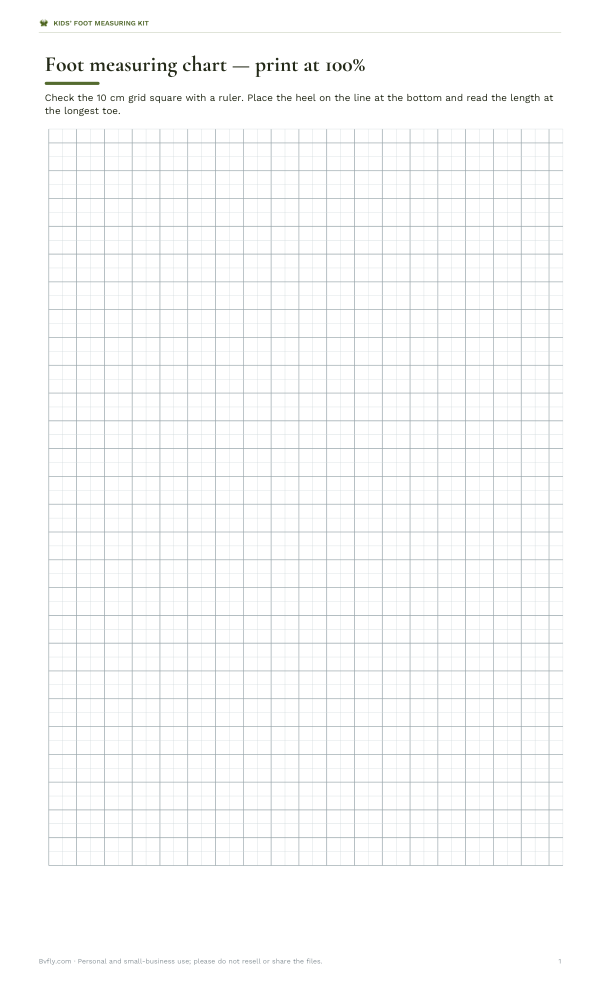
Printable actual-size foot measuring chart (0–26 cm), a kids’ shoe size conversion chart, a family shoe size tracker and a shoe fitting checklist.
- Actual-size foot chart (PDF)
- Size conversion chart (PDF, XLSX)
- Family size tracker (XLSX)
- Fitting checklist (PDF, DOCX)
Formats: PDF, XLSX, DOCX. Instant download after payment (link valid 72 hours, up to 5 downloads). AI-assisted: the templates were drafted with AI help and reviewed and laid out before publishing.
$5.00 USD, one-time 4 files · about $1.25 each
- Instant download
- 7-day refund
- Secure checkout by Stripe
7-day money-back guarantee. Full refund within 7 days of purchase, even after you download.
Free sample: Family Shoe Size Tracker (PDF, 59 KB)
Full refund within 7 days — see the refund policy and license.
Free printables
Single sheets you can print right now, no sign-up. The full pack adds every sheet in one download plus the editable files.
 Printable Children’s Shoe Fitting Checklist
How to measure your child’s feet
- Measure later in the day, when feet are at their largest.
- Have your child stand (not sit) on a sheet of paper with their heel against a wall, weight on both feet, wearing the socks they usually wear.
- Mark the tip of the longest toe — not always the big toe — with a pencil held upright.
- Measure from the wall to the mark with a ruler.
- Measure both feet and use the longer one.
- Enter the length above; the finder adds growing room automatically.
For babies and toddlers who will not stand still, trace around the foot while they stand and measure the tracing, subtracting a couple of millimetres for the pencil line.
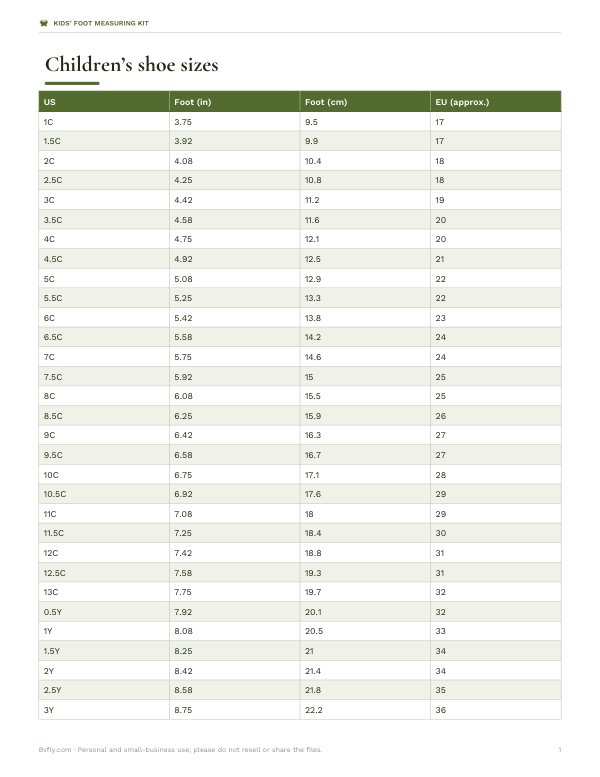
US children’s shoe size chart
| US size | Foot length (in) | Foot length (cm) |
|---|---|---|
| 1C | 3.75 | 9.5 |
| 2C | 4.08 | 10.4 |
| 3C | 4.42 | 11.2 |
| 4C | 4.75 | 12.1 |
| 5C | 5.08 | 12.9 |
| 6C | 5.42 | 13.8 |
| 7C | 5.75 | 14.6 |
| 8C | 6.08 | 15.5 |
| 9C | 6.42 | 16.3 |
| 10C | 6.75 | 17.1 |
| 11C | 7.08 | 18.0 |
| 12C | 7.42 | 18.8 |
| 13C | 7.75 | 19.7 |
| 1Y | 8.08 | 20.5 |
| 2Y | 8.42 | 21.4 |
| 3Y | 8.75 | 22.2 |
| 4Y | 9.08 | 23.1 |
| 5Y | 9.42 | 23.9 |
| 6Y | 9.75 | 24.8 |
| 7Y | 10.08 | 25.6 |
US kids’ sizes run from infant and toddler sizes marked “C” (child), usually up to 13C, then continue as youth or “big kid” sizes 1Y to about 7Y. Each full size step is one-third of an inch (about 8.5 mm) of foot length. Half sizes sit in between. This chart follows the common Brannock-style scale; brands differ slightly.
How much growing room?
A common guideline is about 1–1.5 cm (roughly a child’s thumb width, or ⅜–⅝ inch) between the longest toe and the end of the shoe. That leaves room for the foot to move and grow without the shoe being so big that the child trips or the heel slips. For first walkers, choose closer to 1 cm. Avoid buying two sizes up “to grow into” — shoes that are too long change how children walk.
How fast do children’s feet grow?
| Age | Typical growth | Check size every |
|---|---|---|
| Under 15 months | About half a size every 2 months | 6–8 weeks |
| 15 months – 2 years | About half a size every 3 months | 2–3 months |
| 2–3 years | About half a size every 4 months | 3–4 months |
| 3–5 years | About half a size every 4–6 months | 4 months |
| 5 years and older | About half a size every 6 months or more | 4–6 months |
These are typical ranges often quoted by children’s footwear fitters; every child grows at their own pace, often in spurts.
The thumb and finger tests
- Thumb test — with your child standing, press gently at the front of the shoe: there should be about a thumb’s width between the longest toe and the end.
- Heel test — you should be able to slip your little finger behind the heel, but not easily more.
- Width — the shoe should not bulge at the sides, and the toes should be able to wiggle.
- Walk test — watch your child walk; the heel should stay in the shoe and they should not trip or shuffle.
- Red marks — check for red marks after the shoes have been worn for a while.
Converting between US, UK and EU sizes
UK children’s sizes run about one size below US sizes (a US 8C is roughly a UK 7). EU sizes use the Paris point system (two-thirds of a centimetre per size) based on the shoe’s inside length; a practical approximation is EU size ≈ 1.5 × (foot length in cm + 1.5). Mondopoint, used for ski boots and some school shoes, is simply the foot length in millimetres. Because brands build their sizes on different lasts, always check the brand’s own chart.
Worked example
A four-year-old’s longest foot measures 17.0 cm. Adding 1.25 cm of growing room gives an inside length of about 18.3 cm. The finder suggests a US 11.5C (about 18.4 cm inside length), UK 10.5 and EU 28. When trying the shoes, the parent does the thumb test at the toe and checks the heel, then sets a reminder to measure again in four months.
Choosing good children’s shoes
- Flexible soles that bend where the toes bend.
- A roomy toe box that lets toes spread.
- Secure fastening (Velcro, laces or buckles) so the foot does not slide.
- Breathable uppers.
- Barefoot time at home is good for developing feet; shoes are for protection outdoors.
- Hand-me-down shoes may have moulded to another child’s feet — check fit carefully.
Privacy
The size finder runs in your browser and does not store your child’s measurements.
Frequently asked questions
How do I know my child’s shoe size?
Measure the longest foot from heel to longest toe and use the chart, adding about 1–1.5 cm of growing room.
What does the C mean in shoe sizes?
C stands for child — infant and toddler sizes up to about 13C. Y means youth or big kid sizes.
How much room should children’s shoes have?
About a thumb’s width, 1–1.5 cm, beyond the longest toe.
What size comes after 13C?
1Y (youth size 1).
How often should I check my child’s shoe size?
Every 2–4 months for toddlers and every 4–6 months for older children.
Is my child’s data stored?
No, everything stays in your browser.